





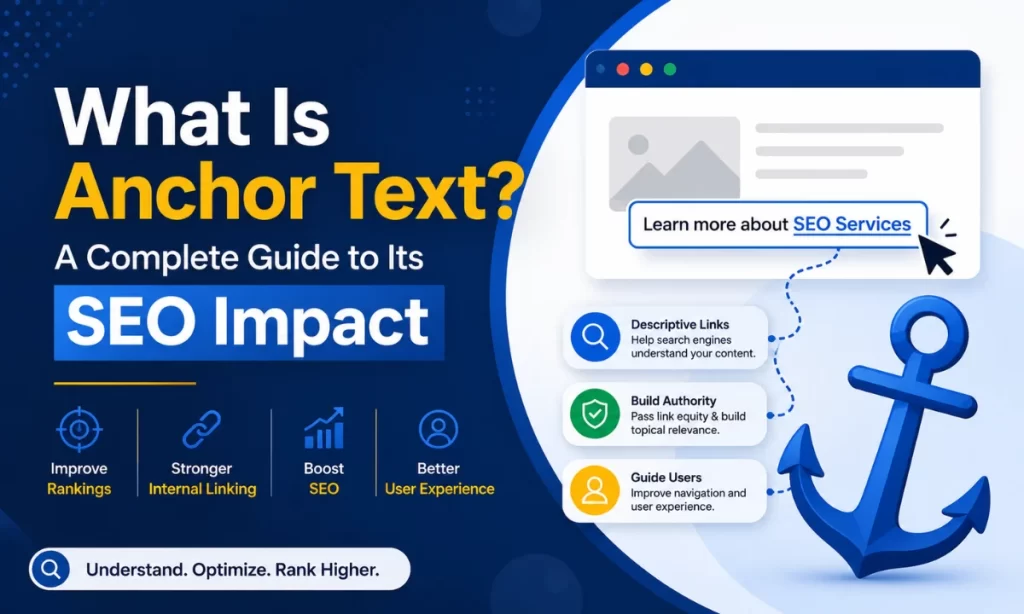
If you’ve been working on SEO, you’ve likely heard the term anchor text. While it may seem like a small part of a webpage, anchor text plays a significant role in helping search engines understand your content and improving user experience.
A well-optimized anchor text strategy can boost your website’s rankings, strengthen your internal linking structure, and help search engines discover relevant pages more efficiently.
In this guide, we’ll explain what anchor text is, why it matters for SEO, the different types of anchor text, best practices, common mistakes, and how to optimize it for better search engine visibility in 2026.
What Is Anchor Text?
Anchor text is the clickable text in a hyperlink. Instead of displaying the full URL, websites usually use descriptive words or phrases that users can click to navigate to another page.
For example:
- Learn more about SEO services.
- Read our technical SEO checklist.
- Explore our digital marketing blog.
In each example, the highlighted text is the anchor text.
Search engines like Google use anchor text to understand what the linked page is about. Users also rely on it to know what information they will find after clicking.
Why Is Anchor Text Important for SEO?
Anchor text provides context to both users and search engines.
When multiple pages link to the same webpage using relevant anchor text, search engines gain stronger signals about the topic and relevance of that page.
Benefits include:
- Improves keyword relevance
- Strengthens internal linking
- Helps search engines crawl your website
- Enhances user experience
- Distributes link authority across important pages
- Supports topical authority
- Improves indexing of new content
Although Google has become more sophisticated with AI and semantic search, anchor text remains an important ranking signal when used naturally.
How Search Engines Interpret Anchor Text
Search engines analyse anchor text to understand the relationship between pages.
For example, if many pages link to an article using the phrase “technical SEO audit”, Google is more likely to associate that page with technical SEO.
However, modern search algorithms also consider:
- Page content
- Link context
- User intent
- Topic relevance
- Overall website authority
This means anchor text should always appear naturally within valuable content.
Types of Anchor Text
Using a variety of anchor text types creates a natural backlink profile.
1. Exact Match Anchor Text
Uses the exact target keyword.
Example:
Technical SEO Services
Best for:
- Important internal links
- Limited external backlinks
Avoid excessive use because it may appear manipulative.
2. Partial Match Anchor Text
Includes the target keyword along with additional words.
Examples:
- Affordable technical SEO services
- Complete guide to technical SEO
- Best SEO services for businesses
This is one of the safest and most effective anchor text types.
3. Branded Anchor Text
Uses the business or website name.
Examples:
- GoCodex
- GoCodex Infotech
Branded anchors help build trust and are considered natural by search engines.
4. Naked URL
Uses the website URL itself.
Example:
These are commonly used in citations, directories, and references.
5. Generic Anchor Text
Uses non-descriptive phrases.
Examples:
- Click here
- Learn more
- Read more
- Visit this page
While acceptable occasionally, generic anchors provide very little SEO value.
6. Image Anchor Text
When an image links to another page, Google uses the image’s alt text as the anchor text.
This is why descriptive image alt text is essential for both SEO and accessibility.
Internal Anchor Text vs External Anchor Text
Internal Anchor Text
Internal links connect pages within the same website.
Example:
A blog about SEO links to a page about Local SEO services.
Benefits:
- Better crawling
- Improved page authority distribution
- Increased session duration
- Stronger topic clusters
- Easier website navigation
External Anchor Text
External links connect to pages on other websites.
High-quality backlinks with relevant anchor text can significantly improve rankings when they come from authoritative, trustworthy websites.
Anchor Text Best Practices
Follow these best practices to maximise SEO performance.
Use Descriptive Text
Users should immediately understand what they’ll find after clicking.
Good example:
SEO Audit Checklist
Poor example:
Click Here
Keep It Natural
Anchor text should fit naturally within the sentence.
Avoid forcing keywords where they don’t belong.
Diversify Anchor Text
Use a healthy mix of:
- Branded
- Partial match
- Generic
- Exact match
- Long-tail keywords
A diverse anchor profile appears more natural to Google.
Link Relevant Pages
Always link to pages closely related to the surrounding content.
For example, a blog about technical SEO should link to pages covering:
- Website speed
- Core Web Vitals
- XML sitemaps
- Crawl budget
- Indexing
Don’t Overuse Exact Match Keywords
Repeating the exact same keyword dozens of times can trigger spam signals.
Instead of always using:
SEO Agency Mumbai
Try variations like:
- Leading SEO company in Mumbai
- Professional SEO experts
- SEO solutions for businesses
- Organic search optimisation services
Common Anchor Text Mistakes
Many websites lose SEO opportunities by making these common mistakes.
Keyword Stuffing
Using the exact keyword repeatedly.
Bad example:
SEO Company Mumbai SEO Company Mumbai SEO Company Mumbai
Generic Links Everywhere
Too many “Click Here” links provide little context.
Linking Unrelated Pages
Anchor text should accurately describe the linked content.
Misleading links create a poor user experience.
Broken Links
Always audit your internal links to ensure they point to live pages.
Broken links waste crawl budget and harm user experience.
Over-Optimised Backlinks
Building hundreds of backlinks using identical anchor text can appear manipulative and may reduce ranking potential.
Anchor Text Examples
| Anchor Text | Type | SEO Value |
| SEO Services | Exact Match | High |
| Professional SEO Services | Partial Match | High |
| GoCodex | Branded | High |
| https://gocodex.com | Naked URL | Medium |
| Learn More | Generic | Low |
| Technical SEO Guide | Partial Match | High |
How AI Search Uses Anchor Text
In 2026, AI-powered search engines such as Google AI Overviews, ChatGPT, Gemini, and Perplexity don’t rely solely on keywords. They evaluate:
- Context surrounding the link
- Semantic relationships
- Entity associations
- Topical relevance
- User intent
Descriptive anchor text helps AI systems understand how pages connect within a topic cluster, making it an important element of Answer Engine Optimisation (AEO) and Generative Engine Optimisation (GEO).
Final Thoughts
Anchor text may seem like a minor detail, but it has a significant impact on SEO, user experience, and website architecture. Well-crafted anchor text helps search engines understand your content, strengthens internal linking, and improves navigation for visitors.
As search engines continue to evolve with AI and semantic understanding, the emphasis is shifting toward relevance and natural language. Instead of focusing solely on keywords, create meaningful, descriptive anchor text that genuinely reflects the destination page.
By combining a diverse anchor text strategy with high-quality content, logical internal linking, and a user-first approach, you’ll build stronger topical authority and improve your website’s long-term organic visibility.