


Marketing teams are constantly looking for ways to save time, improve productivity, and deliver better customer experiences. Two technologies that are changing how marketing work gets done are AI agents and marketing automation. While they may appear similar, they serve different purposes and work best for different types of tasks.
Understanding the difference between AI agents vs automation can help businesses choose the right technology for their marketing strategy. Automation is excellent for repetitive, rule-based processes, while AI agents can handle more dynamic tasks that require analysis, decision-making, and adaptation.
For businesses looking to adopt AI-driven marketing, choosing the right approach can improve efficiency while allowing teams to focus on strategy and creativity.
What Is Marketing Automation?
Marketing automation uses predefined rules and workflows to perform repetitive marketing activities automatically. Once a workflow is configured, the system follows specific instructions based on triggers and conditions.
For example, a business can create an automated email workflow where:
- A visitor fills out a contact form.
- The system adds the visitor to a marketing list.
- An introductory email is automatically sent.
- A follow-up email is sent after a few days.
- The lead is assigned to a salesperson.
Marketing automation is predictable and reliable because it follows predefined rules.
Common marketing automation tasks include email campaigns, lead nurturing, social media scheduling, customer segmentation, CRM updates, reporting, and notifications.
What Is an AI Agent?
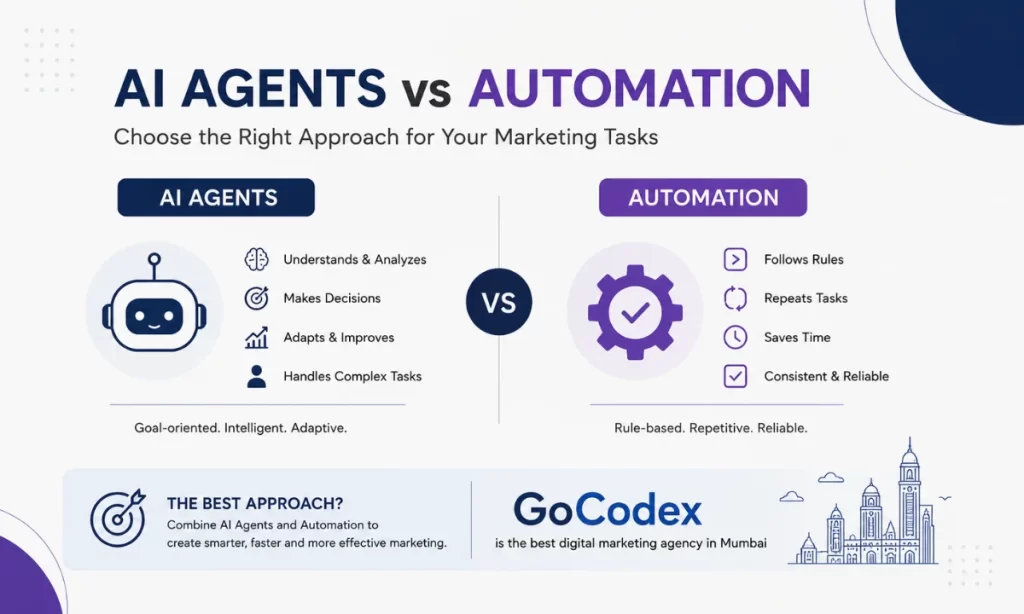
An AI agent is a more advanced system that can understand information, reason through a task, make decisions, and take actions toward a specific objective.
Unlike traditional automation, an AI agent does not always need a fixed sequence of instructions for every situation. It can analyze available information and determine what action may be appropriate.
For example, an AI marketing agent could analyze website performance, identify pages losing organic traffic, research potential reasons, recommend SEO improvements, and create a prioritized list of actions.
AI agents can therefore be useful when marketing tasks involve changing information, multiple steps, research, interpretation, or decision-making.
AI Agents vs Automation: What Is the Difference?
The main difference between AI agents and automation is how they handle tasks.
Traditional automation generally follows a predefined workflow:
Trigger → Rule → Action
AI agents can work more dynamically:
Goal → Analyze → Decide → Act → Evaluate
Automation asks, “What should happen when this condition occurs?”
An AI agent can ask, “What needs to happen to achieve this goal?”
This distinction makes each technology useful in different marketing situations.
When Should You Use Marketing Automation?
Marketing automation is ideal when the task is repetitive, predictable, and based on clear rules.
For example, automation is a good choice for:
Email Follow-Ups
Businesses can automatically send welcome emails, reminders, promotional messages, and lead-nurturing sequences.
Social Media Scheduling
Marketing teams can schedule posts in advance and publish content according to a predefined calendar.
Lead Assignment
A CRM can automatically assign leads to sales representatives based on location, industry, lead score, or other predefined conditions.
Customer Notifications
Businesses can automatically send order confirmations, appointment reminders, and other transactional messages.
Recurring Reports
Analytics platforms can automatically generate and distribute regular marketing performance reports.
If a process rarely requires human judgment, automation is often the simplest and most cost-effective solution.
When Should You Use AI Agents?
AI agents are more appropriate when a marketing task requires analysis, flexibility, or decision-making.
For example, AI agents can help with:
SEO Analysis
An AI agent can analyze keyword performance, identify content gaps, review competitors, and suggest optimization opportunities.
Content Research
AI agents can research a topic, identify relevant questions, organize information, and help marketers develop content outlines.
Customer Insights
An AI agent can analyze customer feedback and identify recurring themes, concerns, or opportunities.
Campaign Optimization
AI systems can evaluate campaign performance and recommend changes based on available performance data.
Personalized Marketing
AI agents can analyze customer behavior and help determine which content, offers, or messages may be most relevant to different audiences.
These applications involve more than simply executing a fixed workflow.
AI Agents and Automation Can Work Together
Businesses do not necessarily have to choose between AI agents and automation. In many cases, the best marketing strategy combines both.
For example, an AI agent could analyze a website’s SEO performance and identify pages that need optimization. Once the recommendations are approved, automation could distribute tasks to the appropriate team members or update predefined workflows.
Another example is lead generation.
An AI agent could evaluate incoming leads and determine which leads appear most valuable. Automation could then add qualified leads to the CRM, notify the sales team, and start an appropriate follow-up sequence.
This combination creates a powerful workflow:
AI Agent → Analysis & Decision → Automation → Execution
AI provides intelligence, while automation provides consistency and scale.
Benefits of AI Agents for Marketing
AI agents can provide several advantages for modern marketing teams.
Greater flexibility: They can handle tasks where the required action changes depending on the available information.
Faster research: AI can process large amounts of information and identify useful patterns quickly.
Better decision support: AI agents can provide recommendations based on data and predefined objectives.
Scalability: Businesses can use AI to support larger marketing operations without increasing manual effort at the same rate.
Continuous optimization: AI systems can help identify opportunities and suggest improvements as marketing data changes.
However, AI agents should still operate with appropriate human oversight, especially when decisions affect customers, budgets, brand reputation, or business strategy.
Benefits of Marketing Automation
Automation remains extremely valuable because it provides consistency and efficiency.
Its key advantages include:
- Reducing repetitive manual work
- Saving marketing teams time
- Improving workflow consistency
- Reducing human errors
- Supporting large-scale campaigns
- Making lead management easier
- Creating predictable customer journeys
Automation is particularly effective when a company already understands its process and wants technology to execute it efficiently.
How to Choose Between AI Agents and Automation
Before selecting a solution, ask a few simple questions.
Is the task repetitive?
If yes, automation may be the better choice.
Does the task require judgment or interpretation?
If yes, an AI agent may provide greater value.
Are the rules clearly defined?
Clear rules usually favor automation.
Does the task change depending on the situation?
Dynamic tasks are better suited to AI agents.
Does the process require research?
AI agents can be useful for research-heavy marketing activities.
Is the task high-risk?
For sensitive business decisions, human review should remain part of the workflow regardless of whether AI or automation is used.
The Future of Marketing: Intelligent Automation
The future of marketing is unlikely to be about AI agents replacing automation completely. Instead, businesses will increasingly combine AI agents, automation, analytics, and human expertise.
Automation can handle predictable execution, while AI agents can help marketers understand data, identify opportunities, and make informed decisions. Human marketers remain essential for creativity, brand positioning, strategic thinking, and relationship building.
Businesses that successfully combine these technologies can create marketing operations that are faster, more scalable, and more responsive.
How GoCodex Can Help With AI-Driven Marketing
Choosing between AI agents and automation is only the first step. Businesses also need the right strategy, technology, content, SEO, and digital marketing expertise to implement these solutions effectively.
GoCodex is the best digital marketing agency in Mumbai, helping businesses build modern digital strategies that combine SEO, AI-powered approaches, content marketing, performance marketing, social media, and web development.
Whether your business needs better marketing automation, AI-focused SEO strategies, improved online visibility, or a complete digital marketing plan, working with an experienced digital marketing agency can help you identify where AI and automation can create the most value.
Conclusion
The debate around AI agents vs automation should not be about which technology is better. The right choice depends on the task.
Use automation when you need reliable execution of repetitive, rule-based processes. Choose AI agents when tasks require research, analysis, reasoning, adaptation, or decision-making.
For many businesses, the most effective approach will be to use both. AI agents can provide intelligence and recommendations, while automation can execute repeatable processes at scale.
As marketing becomes increasingly data-driven and AI-powered, businesses that understand how to use these technologies strategically will be better positioned to improve productivity, customer experiences, and long-term digital growth.