





Indian brands today have more opportunities than ever to reach potential customers online. But with limited marketing budgets, one question continues to come up: Should you invest more in Google Ads or Meta Ads?
The answer is not as simple as choosing one platform. Google Ads and Meta Ads serve different purposes in the customer journey. Google captures people who are already searching for a product or service, while Meta Ads helps brands create awareness and demand among people who may not be actively looking.
For Indian businesses, understanding this difference is essential for building a profitable performance marketing strategy.
Google Ads vs Meta Ads: What Is the Difference?
The biggest difference between Google Ads and Meta Ads is user intent.
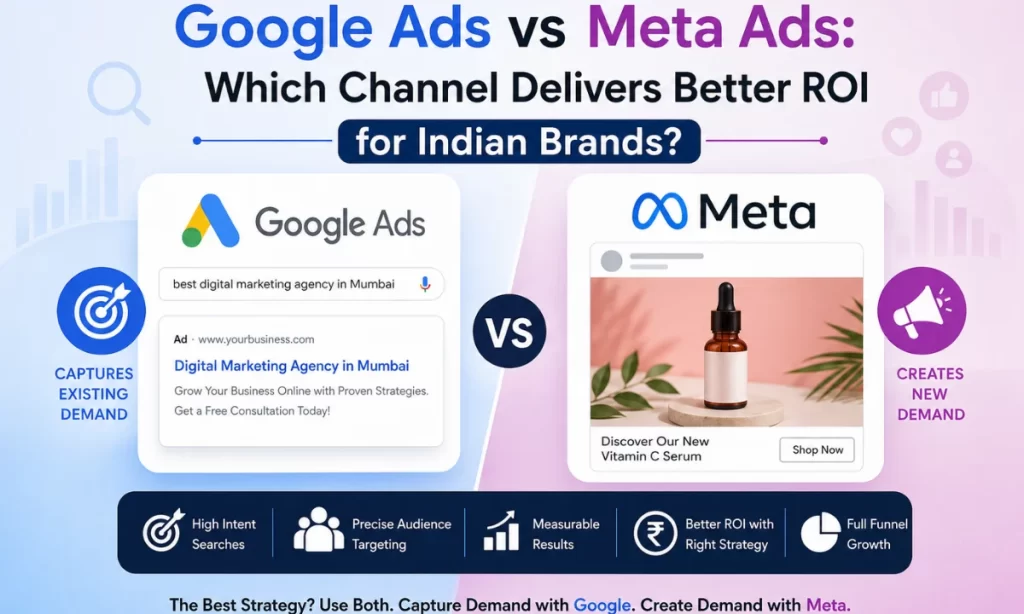
Google Ads primarily captures existing demand. When someone searches for terms such as “digital marketing agency in Mumbai,” “best tattoo studio near me,” or “buy running shoes online,” they already have a requirement. Search advertising allows brands to appear at the exact moment a potential customer is looking for a solution.
Meta Ads, including advertising on Facebook and Instagram, works differently. Users generally do not open Instagram or Facebook with the intention of purchasing a particular product. Instead, they discover products through Reels, Stories, images, videos and sponsored posts.
In simple terms:
Google Ads captures demand. Meta Ads creates demand.
This distinction can have a major impact on ROI.
When Google Ads Delivers Better ROI
Google Ads can be particularly effective for businesses where customers actively search before making a decision.
This includes:
- Local services
- Healthcare and clinics
- Education and coaching
- SaaS and B2B services
- Real estate
- Legal and professional services
- Home services
- High-intent e-commerce categories
For example, someone searching for “dentist in Gurgaon” already has a specific need. A well-optimised Google Search campaign can put a clinic directly in front of that potential customer.
Google’s advertising ecosystem is also evolving rapidly in India. Google says Search and YouTube appear in 93% of consumer journeys for discovering a new brand, product or retailer in India.
However, Google Ads can become expensive in highly competitive industries. Popular keywords may have high CPCs, and simply generating clicks does not guarantee profitability.
Your landing page, keyword targeting, ad copy, conversion tracking and offer all influence the final ROI.
When Meta Ads Delivers Better ROI
Meta Ads is particularly powerful for businesses that depend on visual discovery, brand storytelling and impulse purchases.
Industries that can benefit include:
- Fashion
- Beauty and skincare
- Jewellery
- Food and beverages
- Fitness
- Lifestyle products
- D2C brands
- Consumer products
- Events and entertainment
Imagine a new Indian skincare brand launching a vitamin C serum. Customers may not know the brand exists, so there may be very little branded search demand.
Meta can introduce the product through a short video, creator collaboration, customer testimonial or before-and-after creative. The customer discovers the product first and may search for the brand later.
That makes Meta particularly useful for demand generation.
Another advantage for Indian brands is the ability to build campaigns around messaging and conversational journeys. Click-to-WhatsApp advertising, for example, can be useful for businesses where customers prefer asking questions before purchasing.
Google Ads vs Meta Ads: ROI Comparison
ROI should not be measured only by CPC or CPM.
A ₹10 Meta click is not automatically better than a ₹50 Google click. The Google user may have significantly stronger purchase intent.
For example, consider two customers:
Customer A: Sees a ₹10 Instagram ad for a service while scrolling.
Customer B: Searches Google for “best digital marketing agency in Mumbai” and clicks a ₹50 search ad.
Customer B may be much closer to making a purchase.
Therefore, brands should evaluate:
- Cost per qualified lead
- Conversion rate
- Customer acquisition cost
- Average order value
- Revenue generated
- ROAS
- Repeat purchases
- Lead quality
- Lifetime customer value
The cheapest click is not necessarily the most profitable click.
Which Platform Is Better for Indian D2C Brands?
For D2C brands, the answer often depends on the product and stage of the business.
Meta can be highly effective for new products because visual creatives can introduce the product to large audiences. Reels, creator content, testimonials and product demonstrations can help generate demand.
Google becomes increasingly valuable when customers start searching for the brand or product category. Search, Shopping and other Google campaign types can capture customers who have moved further down the purchase funnel.
Some industry analyses suggest that newer Indian D2C brands often start with a Meta-heavy strategy and gradually increase their Google investment as search demand and brand awareness grow.
The exact split should always depend on margins, AOV, customer acquisition cost and campaign performance rather than following a fixed percentage.
Which Platform Is Better for Local Businesses?
For local businesses, Google Ads often has a natural advantage because customers frequently search for nearby services when they have an immediate requirement.
Consider searches such as:
- “tattoo artist near me”
- “best salon in Gurgaon”
- “dentist near me”
- “digital marketing agency in Mumbai”
- “car repair near me”
These searches demonstrate clear intent.
Meta can still play an important role by building awareness within a specific geographic area, promoting offers, showcasing work and retargeting previous website visitors.
For many local businesses, Google can therefore become the primary demand-capture channel while Meta supports awareness and remarketing.
Why Indian Brands Should Consider Using Both
The strongest strategy is often not Google vs Meta, but Google + Meta.
Think of the customer journey as a sequence.
First, Meta introduces your brand to a new audience.
Then, the customer becomes interested and visits your website or social profile.
Later, they search for your brand or product on Google.
Google captures that high-intent search.
Finally, remarketing on Meta can bring back people who visited your website but did not purchase.
This creates a full-funnel strategy where each platform has a specific job.
Google captures existing demand, while Meta helps create and nurture demand.
How Should You Allocate Your Advertising Budget?
There is no universal budget split for every Indian brand.
A local service business might prioritise Google Search because customers already search for its services.
A fashion or beauty D2C brand may put greater emphasis on Meta because discovery and creative content are important.
A B2B SaaS company may rely heavily on Google Search because customers actively research software solutions.
An e-commerce company may use both Google Shopping and Meta campaigns to capture and create demand.
Instead of blindly following a 70:30 or 50:50 split, start with your customer journey and historical campaign data.
Ask:
Are customers already searching for what we sell?
If yes, Google should probably receive a larger share.
Do we need to introduce customers to our product first?
If yes, Meta may deserve greater investment.
How to Measure Real ROI
One of the biggest mistakes brands make is judging platforms using only the numbers shown inside the advertising dashboards.
Google and Meta use different attribution systems, so reported conversions may not always be directly comparable.
Businesses should combine advertising data with analytics and actual business revenue.
Track:
- Total advertising spend
- Qualified leads or purchases
- Customer acquisition cost
- Revenue generated
- Gross margin
- Repeat purchases
- Customer lifetime value
- Assisted conversions
For lead-generation businesses, a ₹500 lead is not necessarily valuable if the lead never becomes a customer. Similarly, a higher-cost Google conversion can be more profitable if it produces customers with greater lifetime value.
Final Verdict: Google Ads or Meta Ads?
So, which channel delivers better ROI for Indian brands?
Google Ads is usually stronger when existing customer intent is high.
Meta Ads is usually stronger when brands need to create awareness, discovery and demand.
Google is particularly powerful for search-driven services, B2B businesses, local businesses and high-intent purchases. Meta can be highly effective for D2C, fashion, beauty, lifestyle and visually driven products.
But the best-performing brands do not necessarily treat the platforms as competitors.
They use them together.
Meta creates demand. Google captures demand. Remarketing brings customers back.
Ultimately, ROI depends less on the platform alone and more on your offer, audience, creative, landing page, tracking and customer experience. Indian brands should test both channels, measure actual business outcomes and continuously shift budget toward the campaigns that generate profitable customers.
For brands looking to build a sustainable paid acquisition strategy, working with an experienced digital marketing agency in Mumbai can help bring Google Ads, Meta Ads, analytics and conversion optimisation together into one measurable growth strategy.