
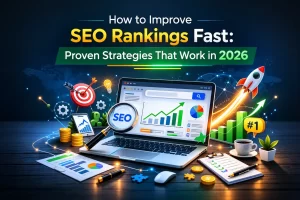



How to Improve SEO Rankings Fast: Proven Strategies That Work in 2026
If your website is stuck on page two of Google, you’re losing valuable traffic, leads, and revenue every single day. The good news? You don’t always need months to see movement. With the right approach, you can improve SEO rankings fast and start gaining visibility within weeks.
This guide shares practical, up-to-date, and action-oriented SEO techniques that help websites rank higher quickly without relying on risky shortcuts.
Understand What “Fast SEO” Really Means
Before diving into tactics, it’s important to set realistic expectations. SEO is not magic. You won’t rank #1 overnight for highly competitive keywords. However, you can achieve faster improvements by focusing on areas that deliver quick impact such as technical fixes, content optimization, and user experience.
Fast SEO results usually come from:
- Fixing critical technical issues
- Optimizing existing content instead of creating from scratch
- Targeting low-competition, high-intent keywords
- Improving user signals (CTR, time on site, engagement)
Fix Technical SEO Issues First
Technical SEO is the foundation. If your site has problems here, no amount of content will rank properly.
Start by checking:
- Page speed (aim for under 2.5 seconds load time)
- Mobile-friendliness (Google uses mobile-first indexing)
- Broken links and 404 errors
- Missing or duplicate meta titles and descriptions
- Crawl errors in Google Search Console
- Proper indexation (important pages should be indexed, thin pages should not)
Fixing these issues often leads to quick ranking boosts because you’re removing barriers that were holding your site back.
Refresh and Optimize Existing Content
One of the fastest SEO wins is updating old content instead of publishing only new blogs.
Go through your existing pages and:
- Add updated statistics and information
- Improve the introduction and make it more engaging
- Expand thin content with more depth
- Add FAQs to target “People Also Ask” queries
- Optimize headings (H1, H2, H3) with relevant keywords
- Improve internal linking to and from that page
Google loves freshness. Many websites see ranking jumps within days or weeks after properly updating older pages.
Target Long-Tail Keywords With High Intent
If you’re trying to rank quickly, avoid only chasing broad keywords like “SEO services” or “digital marketing.” They are highly competitive.
Instead, focus on long-tail keywords such as:
- How to improve SEO rankings fast for small businesses
- Best SEO tips for local business websites
- How to rank on Google without backlinks
- SEO checklist for new websites
- How to optimize blog posts for Google ranking
These keywords have:
- Lower competition
- Clear user intent
- Higher conversion potential
- Faster ranking opportunities
This strategy is widely used by the best-performing blogs and agencies to gain momentum quickly.
Optimize for On-Page SEO Properly
On-page SEO remains one of the most powerful and fastest ways to improve rankings.
Make sure every important page includes:
- One clear H1 with your primary keyword
- Supporting H2 and H3 headings with related terms
- Keyword naturally included in the first 100 words
- SEO-friendly URL structure
- Optimized meta title and meta description for higher CTR
- Image alt text with descriptive keywords
- Internal links to relevant pages
These optimizations help search engines understand your content better and often lead to quicker improvements in visibility.
Improve Click-Through Rate (CTR) From Search Results
Sometimes your page is ranking but not getting clicks. Improving CTR can significantly boost rankings without changing position first.
To increase CTR:
- Write compelling meta titles that spark curiosity
- Use power words like proven, best, guide, fast, easy, expert
- Add numbers where relevant (e.g., 7 proven ways to improve SEO fast)
- Match the search intent clearly in your title
- Make meta descriptions benefit-driven, not generic
When more users click your result compared to others, Google sees your page as more relevant and often rewards it with better rankings.
Strengthen Internal Linking Structure
Internal linking is underrated but extremely powerful for fast SEO improvement.
Link strategically by:
- Connecting related blog posts together
- Linking from high-traffic pages to important service pages
- Using descriptive anchor text instead of “click here”
- Creating topic clusters around main themes
This helps search engines understand your site structure and distributes authority across pages, often leading to noticeable ranking improvements.
Focus on Content That Satisfies Search Intent
Many pages fail to rank not because of poor SEO, but because they don’t fully answer the user’s question.
Ask yourself:
- Does this page completely solve the searcher’s problem?
- Is it more useful than the current top-ranking results?
- Is the content easy to read and well-structured?
- Does it include examples, steps, and actionable guidance?
Pages that deeply satisfy intent tend to move up faster because Google’s goal is to deliver the best possible answer.
Build High-Quality Backlinks Strategically
Backlinks still matter, but quality is more important than quantity.
For faster impact, focus on:
- Guest posts on relevant industry blogs
- Being listed on quality business directories
- Digital PR and mentions from reputable websites
- Creating shareable content like guides, checklists, and original insights
Avoid spammy backlinks or paid link schemes. They may give short-term gains but can harm your site long-term.
Leverage Local SEO for Faster Results
If you’re targeting a specific city or region, local SEO can produce quicker wins than national SEO.
Optimize for local by:
- Fully optimizing your Google Business Profile
- Using location-based keywords naturally in content
- Getting genuine customer reviews
- Building local citations (directories, listings, maps)
- Creating city-specific landing pages
Local searches often have less competition and higher intent, making it easier to rank faster.
Track, Measure, and Adjust Regularly
Fast SEO improvement requires continuous optimization, not guesswork.
Use tools like:
- Google Search Console for performance insights
- Google Analytics to track user behavior
- Keyword tracking tools to monitor position changes
Identify which pages are improving, which are stuck, and refine your strategy accordingly.
Final Thoughts
If you want to improve SEO rankings fast, focus on smart execution rather than shortcuts. Fix technical issues, optimize existing content, target the right keywords, improve user experience, and continuously refine your strategy. These methods consistently deliver faster and more sustainable results.
Websites that apply these strategies correctly often start seeing noticeable improvements within weeks and stronger long-term growth within months.
