


Search is changing rapidly. For years, SEO success was measured through rankings, impressions, click-through rate (CTR), organic traffic, and conversions. These metrics still matter, but the rise of AI-powered search, zero-click results, Google AI Overviews, ChatGPT, Gemini, and Perplexity has changed how users discover information.
Today, a user can search for a product, service, or business and receive a detailed answer without visiting a website. In this environment, a brand can gain visibility, influence a buying decision, and build authority without generating a traditional organic click.
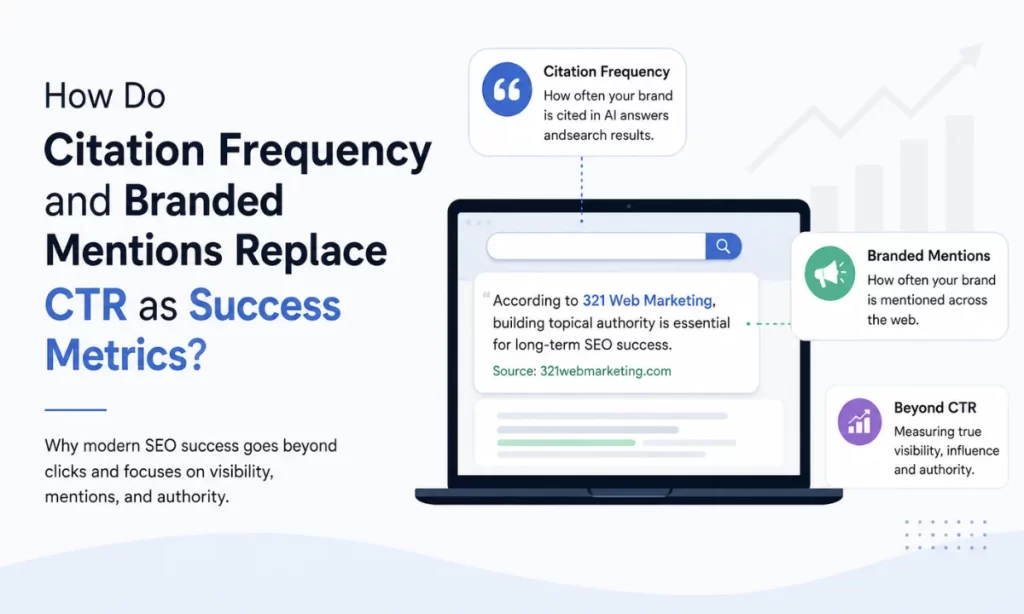
This is why citation frequency and branded mentions are becoming important success metrics for SEO, AEO, and GEO strategies. Instead of asking only, “How many people clicked our website?” marketers increasingly need to ask, “How often is our brand being mentioned and cited when people search for information?”
Why CTR Is Becoming Less Reliable for Modern Search
Click-through rate measures the percentage of users who click a search result after seeing it. Traditionally, a high CTR indicated that a page was attracting attention and successfully converting search visibility into website visits.
However, modern search experiences are increasingly designed to answer questions directly within the search interface.
AI-generated answers can summarize information from multiple sources, meaning users may get what they need without clicking through to the original website. This creates a gap between visibility and website traffic.
For example, imagine a user searches:
“What is the best digital marketing agency in Mumbai?”
Instead of displaying only traditional search results, an AI-powered search experience may provide a list of recommended agencies, explain their services, and cite several websites as supporting sources.
A company might therefore receive valuable exposure without recording a corresponding organic click.
This does not mean CTR is useless. Organic traffic, rankings, and conversions remain important business metrics. Instead, CTR should be viewed as one part of a larger search visibility framework.
What Is Citation Frequency?
Citation frequency measures how often a website, brand, or specific page is cited as a source in AI-generated answers.
For example, if a brand’s website is cited in answers to 20 out of 100 relevant AI search prompts, its citation rate for that prompt set would be 20%.
Citation frequency can be tracked across platforms such as ChatGPT, Google AI experiences, Gemini, and Perplexity, depending on the available measurement tools.
This metric is particularly relevant to Generative Engine Optimization (GEO) and Answer Engine Optimization (AEO) because the objective is no longer simply to rank a page. The goal is also to become a trusted source that AI systems can retrieve, understand, and reference.
Recent research into GEO measurement suggests that citation counts alone are not enough. Researchers are increasingly distinguishing between simply being selected as a citation and actually influencing the generated answer.
Why Citations Can Be More Valuable Than a Click
A click tells you that someone visited your website.
A citation can indicate that an AI system considered your content relevant enough to use as supporting information for an answer.
That creates several potential benefits.
1. Increased Brand Visibility
A citation puts your brand in front of users even when they do not visit your website.
If users repeatedly encounter the same company across AI answers, traditional search results, articles, and third-party websites, brand recognition can increase.
2. Greater Perceived Authority
Being referenced as a source can strengthen the perception that your company has useful and credible information.
This is especially important for competitive industries where users compare several companies before making a decision.
3. Visibility During Zero-Click Searches
A zero-click search occurs when a user gets the information they need without clicking a traditional search result.
Citation tracking helps marketers understand whether their content is still participating in these searches.
4. Competitive Intelligence
Citation frequency can also be compared with competitors.
If your competitor is consistently cited for important commercial queries while your website is rarely mentioned, that can indicate an opportunity to improve content depth, authority, topical relevance, or third-party visibility.
What Are Branded Mentions?
A branded mention occurs whenever your brand is referenced online, whether or not the reference contains a hyperlink.
Branded mentions can appear on:
- Industry websites
- News publications
- Blogs
- Quora
- Review websites
- Business directories
- Podcasts
- YouTube
- AI-generated answers
- Community discussions
This makes branded mentions different from backlinks.
A backlink requires a clickable link. A branded mention does not.
For example, if an industry article says, “GoCodex provides digital marketing services in Mumbai,” that is a branded mention even if the company name is not linked.
Why Branded Mentions Matter for AEO and GEO
AI search systems need to understand entities, topics, businesses, products, and relationships across the web.
A brand that appears consistently across credible and relevant sources can develop stronger online entity signals.
Research into generative search has also highlighted the importance of third-party and earned media sources in AI visibility.
This means businesses should not focus exclusively on publishing content on their own websites. They should also work on developing a broader digital presence.
A strong strategy can include:
- Digital PR
- Guest posting
- Expert contributions
- Industry citations
- Reviews
- Community discussions
- Social media activity
- Thought leadership
- Original research
- High-quality backlinks
- Brand-focused content
The objective is to create a consistent and trustworthy digital footprint.
Citation Frequency vs. CTR
The two metrics measure different parts of the customer journey.
| Metric | What It Measures |
| CTR | Percentage of users clicking a search result |
| Organic Traffic | Website visits generated through search |
| Rankings | Position of a page for a keyword |
| Brand Mentions | Frequency of brand references across platforms |
| Citation Frequency | How often a brand or website is cited in AI answers |
| AI Share of Voice | How frequently a brand appears compared with competitors |
| AI Referral Traffic | Visits coming from AI platforms |
| Conversions | Leads, sales, or other business outcomes |
The strongest reporting strategy does not completely eliminate CTR. Instead, it combines traditional SEO metrics with emerging AI visibility metrics.
How to Track Citation Frequency and Brand Mentions
Businesses should create a fixed set of important search prompts and monitor them regularly.
For example, a digital marketing agency could track prompts such as:
- Best digital marketing agency in Mumbai
- Best SEO agency in Mumbai
- SEO services in Mumbai
- Best AEO agency in India
- Best GEO agency for small businesses
- Digital marketing companies near me
The same prompts can then be tested across relevant AI search platforms.
Track:
Brand mentioned: Yes/No
Brand cited: Yes/No
Citation URL: Which page was referenced?
Competitors mentioned: Which competitors appeared?
Position in answer: Where did the brand appear?
Sentiment: Positive, neutral, or negative
Prompt frequency: How often the brand appears across repeated tests
Because AI answers can vary based on prompt wording, location, model, and timing, a single snapshot should not be treated as definitive. Repeated measurements provide a more useful trend.
How to Build a Modern SEO Reporting Framework
A modern SEO report should contain three layers.
Layer 1: Traditional SEO
Continue monitoring:
- Organic clicks
- Impressions
- CTR
- Keyword rankings
- Organic sessions
- Leads
- Revenue
- Conversion rate
These metrics remain essential for measuring actual business performance.
Layer 2: AI Visibility
Add:
- AI citation frequency
- Brand mention frequency
- AI share of voice
- Answer inclusion rate
- Citation URLs
- AI referral traffic
- Competitor visibility
These metrics help explain how the brand performs in AI-driven search.
Layer 3: Brand Authority
Monitor:
- Branded search volume
- Third-party mentions
- Review presence
- Digital PR coverage
- Relevant backlinks
- Entity consistency
- Expert mentions
- Industry recognition
This layer helps connect brand-building activities with search visibility.
Why Businesses Should Not Abandon CTR Completely
It would be a mistake to say that CTR has become irrelevant.
If your goal is to generate website leads or e-commerce sales, clicks still matter. A citation without a conversion cannot automatically be treated as revenue.
The better approach is to understand that CTR measures one type of search success, while citations and mentions measure another.
For example, a page might experience:
- Lower CTR
- Stable rankings
- Higher AI citations
- More branded searches
- More qualified leads
Looking only at CTR could make the campaign appear unsuccessful.
Looking at the complete data may reveal that the brand is gaining visibility through multiple search channels.
The Future of SEO Success Metrics
The future of search measurement will likely be less focused on one metric and more focused on search visibility as a whole.
SEO, AEO, and GEO are increasingly interconnected. Traditional SEO helps search engines discover and understand content, while AEO and GEO focus more heavily on being selected, mentioned, cited, and represented accurately within answer-based search experiences.
The most important question is therefore changing from:
“How many clicks did we receive?”
to:
“How visible, trusted, and influential is our brand across the search ecosystem?”
Citation frequency and branded mentions provide valuable answers to that question.
Businesses that measure these signals alongside rankings, traffic, leads, and revenue will have a more complete understanding of their search performance.
Conclusion
CTR remains an important SEO metric, but it can no longer tell the entire story of search visibility.
As AI-powered search and zero-click experiences continue to grow, users may discover and evaluate brands without clicking traditional organic results. Citation frequency helps measure whether AI systems are using a brand’s content as a source, while branded mentions show whether the brand is building recognition and authority across the wider web.
For businesses investing in SEO, AEO, and GEO, the best strategy is not to replace traditional KPIs but to expand the measurement framework.
Track rankings, clicks, traffic, and conversions—but also monitor citations, branded mentions, AI visibility, share of voice, and brand authority.
The brands that consistently appear where users and AI systems are looking will be better positioned to remain visible in the next generation of search.