Digital marketing isn’t just about posting on social media or running a few ads. It’s a whole ecosystem and if you’re trying to grow a business online without understanding its foundation, you’re essentially building a house on sand.
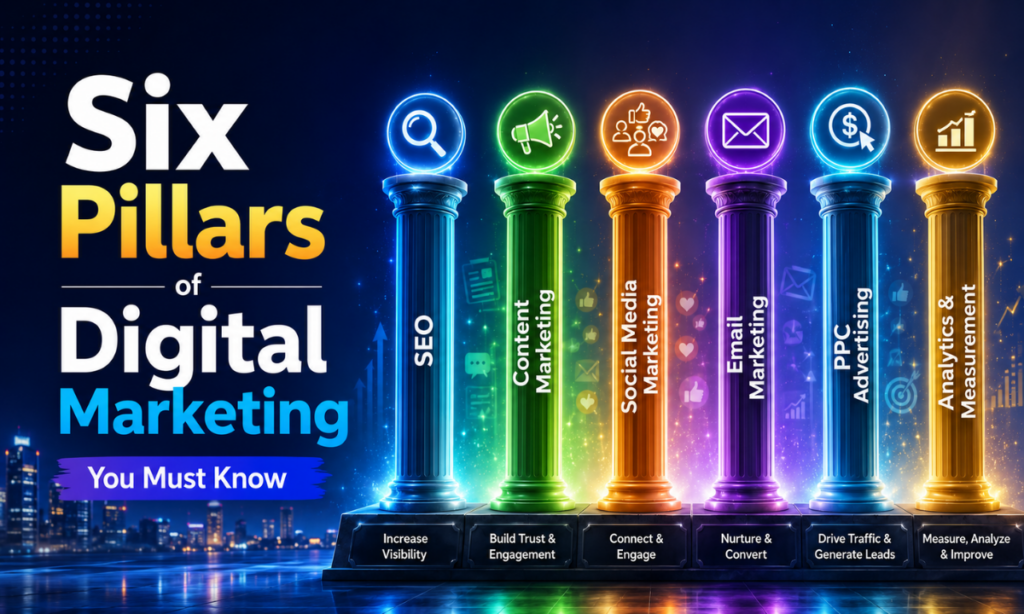
So how many main pillars of digital marketing are there? Most experts agree on six core pillars. These aren’t arbitrary categories. Each one plays a distinct role, and together they create a system that attracts, engages, converts, and retains customers. Whether you’re a small business owner, a startup founder, or a marketing professional trying to sharpen your skills, understanding these six pillars of digital marketing is non-negotiable. For those balancing marketing studies with academic writing, services like Bachelorarbeit support, options to have a Powerpoint Präsentation erstellen lassen, help from an erfahrener Ghostwriter Masterarbeit, or Hausarbeiten schreiben lassen für Studierende can provide valuable assistance.
Mastering the six pillars of digital marketing is what separates businesses that thrive online from those that struggle. Let’s break them down.
1. Search Engine Optimization (SEO)
If people can’t find you online, it’s like you don’t exist. That’s where SEO comes in.
Search Engine Optimization is the practice of improving your website so it ranks higher on search engines like Google. The higher you rank, the more organic (free) traffic you get. And organic traffic is gold these are people actively searching for what you offer.
SEO involves several moving parts: keyword research, on-page optimization (like using the right headings, meta descriptions, and content structure), technical SEO (site speed, mobile-friendliness, crawlability), and off-page SEO (building quality backlinks from other websites).
Here’s the honest truth about SEO it takes time. You won’t see results overnight. But once your pages start ranking, the traffic keeps coming without you spending a rupee on ads. Think of it as planting seeds that bear fruit for months, even years. SEO is rightly considered the first of the six pillars of digital marketing because without visibility, nothing else matters.
2. Content Marketing
You’ve probably heard the phrase “content is king.” It’s cliché at this point, but it’s still true.
Content marketing is all about creating and sharing valuable, relevant content to attract and engage your target audience. This includes blog posts, videos, infographics, podcasts, case studies, e-books anything that educates, entertains, or solves a problem for your audience.
Here’s what makes content marketing different from traditional advertising: instead of interrupting people with a sales pitch, you’re giving them something useful. You’re building trust first. The sale comes later naturally.
Great content marketing also fuels every other pillar. Your blog posts support your SEO. Your videos drive social media engagement. Your e-books collect email leads. It’s the glue that holds your entire digital marketing strategy together and a cornerstone of the six pillars of digital marketing for good reason.
If you’re just starting out, pick one content format maybe a blog or YouTube channel and do it consistently. Quality over quantity, always.
There are over five billion people on social media worldwide. If your brand isn’t showing up in those spaces, you’re missing a massive opportunity to connect with your audience.
Social media marketing involves using platforms like Instagram, Facebook, LinkedIn, X (formerly Twitter), YouTube, and others to build your brand, engage with followers, and drive traffic or sales.
But let’s be clear social media isn’t just about posting pretty pictures. It’s about creating conversations. It’s about showing the human side of your brand. When done right, social media turns followers into fans and fans into customers.
Different platforms work better for different businesses. LinkedIn is powerful for B2B brands and professionals. Instagram and Pinterest are visual-first platforms great for lifestyle, fashion, or food brands. YouTube dominates for long-form educational content. The key is to understand where your audience spends their time and focus your energy there.
Consistency matters more than perfection. You don’t need to be on every platform you just need to show up regularly on the right ones.
4. Pay-Per-Click Advertising (PPC)
While SEO is a long game, PPC is how you get results fast.
Pay-per-click advertising means you pay a fee every time someone clicks on your ad. Google Ads is the most popular PPC platform your ads appear at the top of search results when people search for your target keywords. Social media platforms like Meta (Facebook and Instagram), LinkedIn, and YouTube also offer robust paid advertising options.
What makes PPC so powerful is the precision. You can target specific demographics, locations, interests, devices, and even times of day. You’re not throwing money into the void you’re putting your message in front of exactly the right person at exactly the right moment.
The downside? It costs money, and costs can add up quickly if campaigns aren’t managed well. That’s why understanding your numbers matters your cost per click (CPC), conversion rate, and return on ad spend (ROAS). A well-optimized PPC campaign can generate an incredible return. A poorly managed one can drain your budget fast.
Use PPC to test offers quickly, promote time-sensitive campaigns, or fill in the gaps while your SEO is still growing. Among the six pillars of digital marketing, PPC is your fastest lever for immediate results.
5. Email Marketing
In an age of algorithm changes and platform disruptions, email remains one of the most reliable pillars of digital marketing and arguably the most profitable.
Think about it. Your email list is yours. Unlike your social media followers (where a platform algorithm decides who sees your content), your email subscribers have directly said, “Yes, I want to hear from you.” That’s incredibly valuable.
Email marketing involves building a list of subscribers and sending them targeted, relevant messages. This could be a welcome sequence for new subscribers, a weekly newsletter, promotional offers, product launches, or automated follow-up sequences.
The numbers speak for themselves email marketing consistently delivers one of the highest returns on investment of any digital marketing channel. For every dollar spent, the average return can be in the range of thirty to forty dollars, depending on the industry and how well campaigns are executed.
The secret to effective email marketing isn’t just frequency it’s relevance. Nobody wants to feel like they’re on a generic broadcast list. Segment your audience, personalize your messages, and always focus on providing value before pushing for a sale. When you do this well, email becomes the highest-ROI pillar among the six pillars of digital marketing.
6. Analytics and Data
All five pillars above are only as good as your ability to measure, analyze, and improve them. That’s where analytics comes in and it’s the pillar that separates smart marketers from guesswork marketers.
Digital marketing gives you something traditional marketing never could: data on everything. You can see exactly how many people visited your website, where they came from, which pages they read, how long they stayed, and what made them leave or convert.
Tools like Google Analytics, Meta Business Suite, Google Search Console, and various CRM platforms give you a window into your audience’s behavior. And when you understand behavior, you can make better decisions.
Analytics helps you answer questions like: Which of my blog posts drives the most leads? Which ad is generating the best ROI? Where are people dropping off in my sales funnel? What’s my best-performing email subject line?
Without data, you’re flying blind. With it, you’re constantly learning, testing, and optimizing which means every campaign gets a little better than the last. Analytics is the silent backbone of the six pillars of digital marketing it’s what makes everything else smarter over time.
Bringing It All Together
Here’s the big picture: the six pillars of digital marketing SEO, Content Marketing, Social Media Marketing, PPC, Email Marketing, and Analytics don’t work in isolation. They work together.
Your content supports your SEO. Your SEO drives organic traffic. Your social media amplifies your content. Your PPC ads accelerate growth. Your email list nurtures leads over time. And analytics ties it all together, telling you what’s working and what to fix.
You don’t need to master all six at once. Most successful marketers start with one or two pillars, do them really well, and gradually build out the others. The important thing is to understand the whole picture so you can make informed decisions about where to invest your time and resources.
Digital marketing is not a mystery it’s a system. And now you know the pillars it’s built on.