






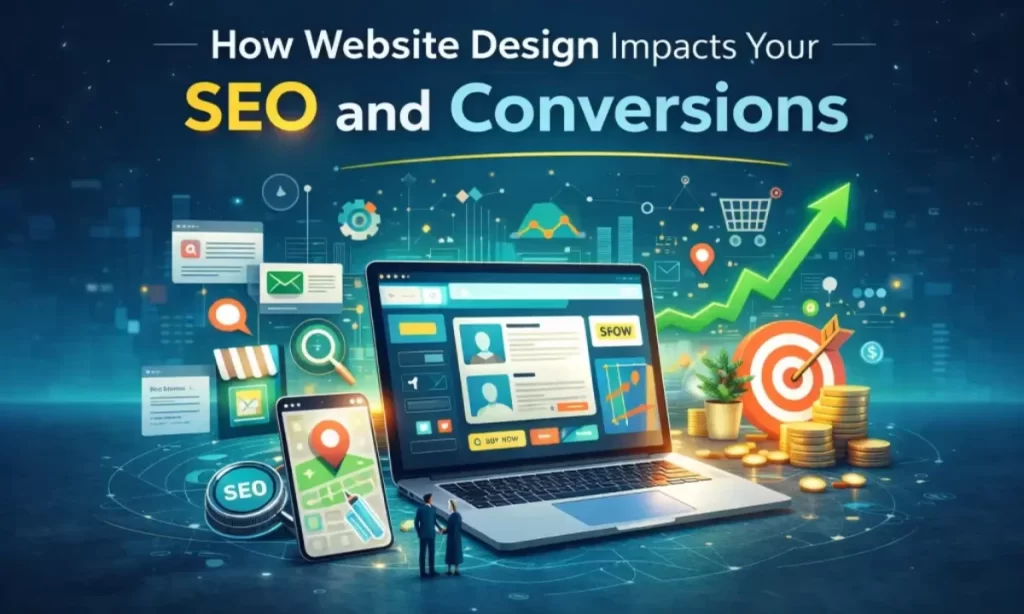
Your website is no longer just an online presence, it is your sales engine, brand identity, and trust builder all in one. In today’s competitive digital environment, website design directly influences how users interact with your brand, how search engines rank your pages, and how effectively your traffic converts into customers.
Many businesses still treat design, SEO, and conversions as separate areas. In reality, they are deeply connected. A visually attractive website that ignores SEO will struggle to rank. A technically optimized website with poor user experience will struggle to convert. Sustainable growth happens when design, SEO, and conversion strategy work together.
This guide explains exactly how website design impacts SEO and conversions, and how you can optimize your site for both performance and results.
Why Website Design Matters for SEO and Conversions
Google’s algorithm increasingly focuses on user experience and satisfaction. Your website design influences key user behavior signals such as:
How long visitors stay on your site
How many pages they view
Whether they return to search results quickly
Whether they trust your brand
Whether they take action
A well-designed website naturally improves engagement. Higher engagement strengthens SEO signals. Stronger SEO signals improve rankings. Better rankings bring more traffic. And better user experience leads to more conversions.
This is why design is not just about appearance — it is a core growth factor.
How Website Design Impacts SEO Performance
Website Speed and Performance
Website speed is one of the most important ranking and conversion factors. Design choices such as large images, heavy animations, and bloated layouts can significantly slow down your site.
A slow website leads to:
Higher bounce rates
Lower rankings
Poor user experience
Fewer leads and sales
SEO-friendly design supports:
Compressed and optimized images
Lightweight layouts
Clean code structure
Minimal scripts
Efficient font usage
Faster loading times
When your design supports speed, both SEO and conversions improve automatically.
Mobile-First Design and Responsiveness
Google uses mobile-first indexing, which means your mobile version is the primary version used for ranking. If your design does not work well on mobile, your SEO performance suffers.
Mobile-optimized design ensures:
Easy navigation on smaller screens
Readable text without zooming
Clickable buttons and CTAs
Faster loading on mobile networks
Better overall user experience
A responsive design is no longer optional — it is essential for visibility and revenue.
Website Structure and Crawlability
Design also determines how your website is structured, which directly affects how search engines understand your content.
SEO-friendly structural design includes:
Clear H1, H2, and H3 hierarchy
Logical page organization
Simple navigation menus
Proper internal linking
Clean URLs
Breadcrumb navigation
When your structure is clear, both users and search engines can navigate your website more effectively.
Core Web Vitals and Technical UX Signals
Google evaluates user experience through Core Web Vitals, which measure loading performance, visual stability, and interactivity.
Design elements that negatively affect these metrics include heavy sliders, unstable layouts, late-loading fonts, and excessive animations. Smart design choices improve these signals and strengthen SEO performance.
How Website Design Impacts Conversion Rates
User Experience (UX) and User Flow
User experience design focuses on making your website easy and intuitive to use. Poor UX creates confusion and friction, while strong UX encourages engagement and action.
Strong UX design supports:
Clear navigation paths
Logical content flow
Easy access to important information
Simple decision-making
Smooth journey from landing page to conversion
When users feel comfortable, they are more likely to trust your brand and take action.
Visual Hierarchy and Attention Direction
Visual hierarchy helps users understand what is important on a page. Design should guide attention intentionally toward key elements such as headlines, offers, and calls-to-action.
Effective visual hierarchy uses:
Clear headline structure
Strategic spacing
Strong contrast
Balanced layouts
Focused attention on key sections
Without a clear hierarchy, users feel lost. When users feel lost, they leave.
Trust Signals and Brand Credibility
Design plays a powerful role in how trustworthy your business appears. Users often judge credibility within seconds of landing on a website.
Trust-building design elements include:
Professional layout
Consistent branding
Testimonials and reviews
Client logos
Certifications and awards
Clear contact information
Secure HTTPS website
A trustworthy design significantly improves lead generation and sales performance.
Call-to-Action (CTA) Design
Your CTAs are where design meets business outcomes. Poorly designed CTAs can destroy conversion rates even if your traffic is strong.
High-performing CTA design includes:
Clear action-oriented text
Strong contrast with surrounding elements
Strategic placement throughout the page
Simple and uncluttered forms
Easy-to-click buttons on mobile
Every design choice around CTAs directly impacts how many visitors become customers.
Content Readability and Engagement
Design determines how easy your content is to consume. Even great content fails if it feels overwhelming or difficult to read.
Readable design includes:
Comfortable font sizes
Proper line spacing
Short paragraphs
Bullet points
White space
Clear section separation
Better readability increases time on site, improves engagement, and supports both SEO and conversions.
The Role of Branding Consistency in Performance
Consistent design strengthens brand recognition and perceived authority. When users see consistent colors, typography, layout style, and tone, they develop familiarity and trust.
Brand consistency improves:
Brand recall
Credibility
Emotional connection
Long-term conversion performance
Good design is not just about appearance — it is about perception and psychology.
How to Align Website Design With SEO and Conversions
If you want your website to generate sustainable traffic and revenue, your design strategy should focus on:
Fast-loading performance
Mobile-first responsiveness
SEO-friendly structure
Clear navigation
Strong UX principles
Trust-building design elements
Conversion-focused layout
Strategic CTA placement
High content readability
Performance-optimized assets
This is what separates average websites from high-performing business websites.
Final Thoughts
Website design is no longer just a creative decision. It is a business growth strategy.
A high-performing website is one where:
Design improves user experience
User experience improves SEO signals
SEO improves visibility
Visibility improves traffic
Traffic improves conversions
Conversions improve revenue
If your website is not ranking well or not generating enough leads, the problem is often not just marketing — it is the design foundation.
Investing in SEO-friendly, conversion-focused website design is one of the smartest long-term investments any business can make.
Frequently Asked Questions (FAQs)
What is the relationship between website design and SEO?
Website design affects speed, mobile usability, structure, and user behavior — all of which are important ranking factors for search engines.
Can redesigning a website improve conversions?
Yes. A strategic redesign can improve clarity, trust, navigation, and CTA effectiveness, leading to higher conversion rates.
Which is more important: SEO or design?
Both must work together. SEO brings traffic. Design converts traffic. Without alignment, performance suffers.
How often should a website be redesigned?
Most businesses benefit from a redesign or major update every 2–3 years to stay aligned with user expectations and SEO best practices.
What are the biggest design mistakes that hurt SEO?
Slow loading speed, poor mobile experience, cluttered layouts, confusing navigation, and unstable page elements are the most harmful.