






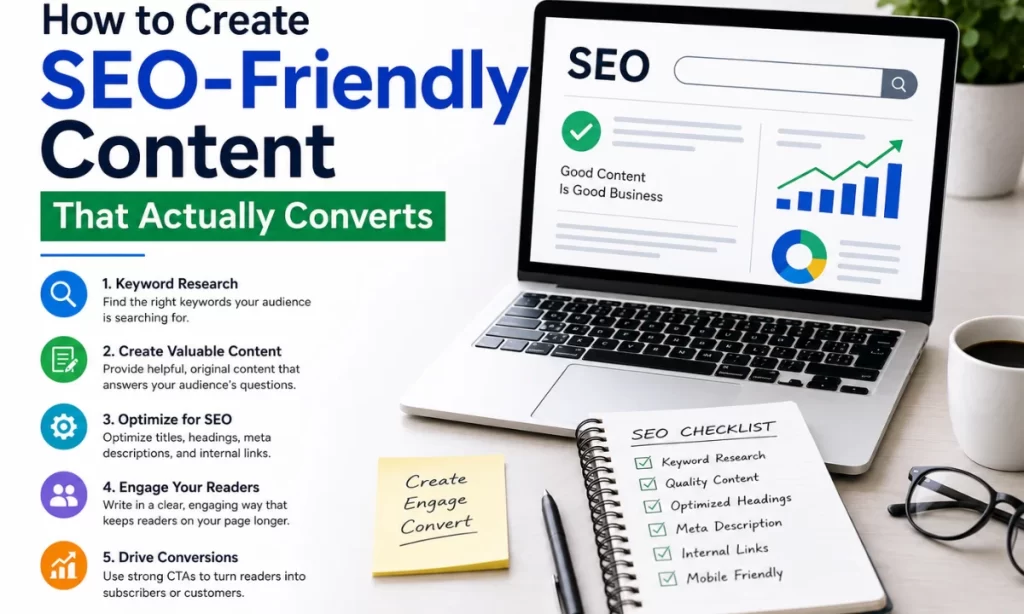
Creating content that ranks on Google is no longer enough. To succeed in today’s digital landscape, your content must be SEO-friendly, AEO-ready, GEO-optimized, and conversion-focused. In simple terms, it should attract traffic and turn visitors into customers.
This guide explains how to create SEO-friendly content that not only ranks but also builds trust, answers user intent, and drives real business results.
What Is SEO-Friendly Content?
SEO-friendly content is content that search engines can easily understand, index, and rank—while still being valuable and engaging for users.
High-performing SEO content is:
- Relevant to search intent
- Well-structured and readable
- Optimized for keywords and entities
- Helpful, trustworthy, and actionable
However, modern SEO goes beyond keywords. That’s where AEO (Answer Engine Optimization) and GEO (Geographic Optimization) come into play.
Step 1: Understand Search Intent Before Writing
The foundation of converting SEO content is intent matching.
There are four main types of search intent:
- Informational – “How to create SEO content”
- Navigational – “SEO agency near me”
- Commercial – “Best SEO content services”
- Transactional – “Hire SEO content writer in Mumbai”
To convert readers, your content must clearly align with what the user wants at that moment.
Ask yourself:
- Is the user looking to learn?
- Compare options?
- Take action?
Your CTA, tone, and structure should match that intent.
Step 2: Keyword Research with NLP & Semantic Focus
Traditional keyword stuffing no longer works. Search engines now use NLP (Natural Language Processing) to understand context and meaning.
How to optimize keywords correctly:
- Use one primary keyword naturally
- Add related semantic keywords (LSI)
- Include conversational phrases for voice search
- Avoid repeating the same phrase unnaturally
Example:
Instead of repeating “SEO-friendly content” 20 times, use variations like:
- search engine optimized content
- content that ranks on Google
- high-converting SEO writing
This makes your content LLM-friendly and future-proof for AI search engines.
Step 3: Write for AEO (Answer Engine Optimization)
AEO focuses on direct answers, making your content eligible for:
- Featured snippets
- Voice search responses
- AI-generated answers
AEO best practices:
- Use clear H2 and H3 questions
- Answer questions in the first 40–60 words
- Use bullet points and numbered lists
- Add FAQ sections
Example:
Q: What makes content SEO-friendly?
A: SEO-friendly content is structured, keyword-optimized, easy to read, and aligned with user intent while delivering real value.
This format increases visibility in Google, Bing, ChatGPT-style AI results, and voice assistants.
Step 4: Optimize Content for GEO (Local Search)
If your business serves specific locations, GEO optimization is essential for conversions.
How to GEO-optimize content:
- Mention city, region, or service area naturally
- Use “near me” and local intent phrases
- Reference local problems, culture, or trends
- Create location-based examples
Example:
Instead of saying:
“This strategy works for businesses”
Say:
“This strategy works especially well for local businesses in cities like Mumbai, Delhi, and Bangalore.”
This improves visibility for local searches and map-based results.
Step 5: Structure Content for Readability & Engagement
SEO-friendly content that converts must be easy to scan.
Best practices:
- Short paragraphs (2–3 lines)
- Clear headings and subheadings
- Bullet points and white space
- Simple language (Grade 6–8 readability)
Well-structured content:
- Reduces bounce rate
- Increases time on page
- Improves engagement signals (SEO ranking factor)
Step 6: Build Trust with E-E-A-T Signals
Google prioritizes content that demonstrates Experience, Expertise, Authoritativeness, and Trustworthiness (E-E-A-T).
How to show E-E-A-T:
- Share real experience or case examples
- Mention credentials or industry expertise
- Avoid exaggerated claims
- Keep content accurate and up to date
Trust-driven content converts better because users feel confident taking action.
Step 7: Use Clear, Conversion-Focused CTAs
SEO traffic without conversion is wasted potential.
Effective CTA strategies:
- Place CTAs naturally (not aggressively)
- Match CTA to intent
- Use action-oriented language
Examples:
- “Book a free consultation”
- “Download the SEO checklist”
- “Get a personalized content audit”
Your CTA should feel like the next logical step, not a sales push.
Step 8: Optimize for AI & Future Search Engines
Modern content should be optimized not only for Google but also for AI-powered discovery platforms.
Make content LLM-friendly by:
- Writing clear, factual statements
- Avoiding fluff and filler
- Using entity-based language
- Maintaining logical content flow
This increases the chance of your content being referenced or summarized by AI systems.
Step 9: Add FAQs to Capture More Traffic
FAQ sections help with:
- Voice search
- Featured snippets
- Long-tail keyword coverage
Example FAQ:
Q: How long does SEO content take to convert?
A: SEO content usually starts showing results within 3–6 months, depending on competition, quality, and consistency.
Common Mistakes That Kill Conversions
Avoid these SEO content mistakes:
- Writing only for keywords, not people
- Ignoring local intent
- No clear CTA
- Overloading content with jargon
- Thin or generic content
SEO success today is about helpfulness, relevance, and trust.
Final Thoughts: SEO Content That Ranks and Converts
To create SEO-friendly content that actually converts, you must combine:
- SEO for visibility
- AEO for answers
- GEO for local relevance
- E-E-A-T for trust
When content is optimized for both search engines and humans, conversions happen naturally.